IT Onboarding Analytics: 8 Key Metrics to Track for Success
Gregg Davis10 min read

A positive onboarding experience helps new employees integrate seamlessly into their roles, maintain user engagement, and minimize turnover.
However, many organizations struggle to create an effective user onboarding strategy. This may impede employee success and business growth.
Fortunately, analytics provide valuable insights and actionable data that help you determine whether your onboarding programs work or not.
In this article, we’ll walk you through the key onboarding metrics for success. But first, let's discuss what analytics are and how they benefit your business.
What is Onboarding Analytics?
Onboarding analytics involves using data to understand and improve how new employees adapt to their roles within an organization.
This systematic approach helps IT companies assess the effectiveness of their onboarding process by tracking various metrics. They include speed to productivity, retention rate, and user satisfaction, among other key indicators.
By analyzing these data points, IT leaders and business owners can identify areas of strength and opportunities for improvement. They can build an effective onboarding strategy that can improve user retention rates and increase user engagement.
Benefits of Tracking Onboarding Analytics
Tracking onboarding analytics can benefit your organization in several ways. Let's look at the six ways IT onboarding analytics can transform the user onboarding process.
Simplify Administrative Processes
Analytics tools help IT teams handle administrative tasks in your organization. They can quickly identify bottlenecks in the setup processes that often frustrate new hires and IT staff.
Onboarding metrics provide valuable insights into how long each step takes, where delays commonly occur, and user feedback. These make it easier to implement more efficient systems for successful onboarding.
Increase Employee Engagement
Employee or user engagement during onboarding is key for long-term retention and job satisfaction.
Detailed analytics allows IT companies to measure how engaged employees are through various stages of their onboarding journey, from initial orientation to training sessions. They track participation rates and feedback forms accomplished by new hires.
By analyzing user behavior and opinions, IT teams can fine-tune approaches to motivate and engage new employees. Tailored communication and content based on data analytics can boost user participation.
Improve Training Effectiveness
Effective training is a key part of a successful onboarding process. and onboarding analytics helps you evaluate the success of your organization’s training programs.
It analyzes completion rates, test scores, and user feedback from new employees about the training materials. This onboarding data allows IT teams to update and improve training methods. It can also help match the training guides with the new users’ unique learning styles and actual needs.
Identify and Address Issues With the Onboarding Process
Sometimes, issues within the onboarding process can go unnoticed until they become major problems.
Fortunately, onboarding analytics serves as a diagnostic tool that helps uncover these complications before they affect your IT business.
Onboarding data gives you insights into different problems affecting the onboarding process. These include insufficient training resources, unclear job role descriptions, or lack of user interactions.
If you can quickly identify pain points through user onboarding data, you can immediately solve them before they escalate. Doing so improves the onboarding experience for everyone.
Prevent Unwanted Employee Turnover
Turnover during the early stages of employment is often a sign of a poor onboarding process.
User onboarding metrics can pinpoint specific stages or aspects in orientation that contribute to new employees quitting their jobs. These usually involve cultural misfits, lack of clarity in job roles, or inadequate support structures.
Thanks to these insights, IT departments can adjust the onboarding process to address various challenges. Doing so can prevent unwanted staff turnover and increase user retention.
Customize Onboarding Experience
New hires have different sets of needs, so a one-size-fits-all approach to onboarding is likely ineffective.
Fortunately, data from IT analytics tools enables you to create a customized onboarding experience.
Analytics shows individual preferences, learning speeds, and needs of various departments. It helps you provide more personalized resources to guide new users in their roles. This makes sure that each person in the onboarding phase feels valued and supported from the start.
8 Key Metrics to Track for IT Onboarding Success
To measure the effectiveness of the IT onboarding program, businesses should monitor several benchmarks. Below are the key metrics to track:
1. Time to Productivity
Time to productivity measures how long it takes for a new hire to become fully productive in their role. It helps determine the effectiveness of the onboarding process in providing the necessary skills and knowledge to employees.
Shorter times to productivity signify a more effective user onboarding process. On the other hand, longer times suggest areas for improvement, such as training and resource allocation.
2. System and Access Setup Efficiency
IT onboarding often depends on how quickly employees gain access to the systems and tools they need. This specific metric tracks the time from their start date to when all access is granted.
Delays can frustrate new hires and slow their progress.
This is why it's important to evaluate the setup process regularly. Automate user provisioning to provide the necessary access to tools on time and without delay.
3. Employee Turnover Rate
The turnover rate of newly hired employees during their first months can also tell you whether the onboarding is successful or not.
A high turnover rate usually indicates the need to optimize your onboarding process. Employees may feel they aren’t a cultural fit or have different skill sets that don’t match the role.
By tracking this user onboarding data, IT organizations can quickly identify and resolve issues to reduce turnover rates.
4. Retention Rate
Retention rate is closely related to turnover. It tracks how many new hires stay with the company over a set period, which is usually over the first year.
A high retention rate suggests that your user onboarding process supports new employees. This makes them more likely to stay with your company in the long term. It is especially important in the IT industry, where the costs of replacing skilled employees are high.
5. New User Satisfaction
Surveys and user feedback help you measure employee satisfaction. They give you insight into how new hires feel about the onboarding process.
High satisfaction levels can lead to higher user engagement, more monthly active users, and increased productivity.
6. Training Completion Rate
Training completion rate is another key metric that helps you track the success of the onboarding process.
It helps you assess how effective the training programs are. It also tells you whether the materials align with the needs and preferred learning pace of your employees.
Lastly, it can indicate the level of engagement new hires need to learn the necessary skills for the job.
7. 360-degree Feedback
360-degree feedback involves collecting insights about the new employees from peers, managers, and the hires themselves.
It provides a well-rounded view of how well new hires are adjusting to the role. Plus, it can suggest both strengths and areas for improvement in the onboarding process.
8. Number of Internal Support Requests
The number of onboarding tickets that new employees submit can offer insights into the effectiveness of your onboarding process.
A large number of requests may suggest that new hires are struggling with certain aspects of their roles.
You should analyze ticket data to identify user concerns and areas for improvement. This information will help you build an effective onboarding process from the start and empower employees for business growth.
Tools and Techniques to Capture IT Onboarding Analytics
After understanding which metrics to track, the next step is understanding how to capture them. The right tools and techniques help you monitor onboarding analytics. Let's take a closer look below:
Employee Onboarding Solutions
IT onboarding software solutions can manage and track onboarding processes from start to finish. These tools often include dashboards for progress monitoring, automated task reminders, and built-in analytics.
Onboarding software can help you track training completion and system setup times, among other key metrics. They also integrate with IT systems and HR platforms, such as SAP SuccessFactors. This integration makes data collection seamless.
IT Ticketing and Workflow Management Systems
Ticketing and helpdesk tools are invaluable for tracking support requests during onboarding. These systems log tickets related to system setup, access issues, or software troubleshooting.
By analyzing ticket trends, you can pinpoint recurring problems. For example, if new hires frequently request access to specific tools, it may signal a need for proactive provisioning.
Monitoring these tickets guarantees smoother onboarding and reduces frustration for new hires.
Data Visualization and Reporting Tools
Raw data is only useful if it’s easy to interpret.
Data visualization and reporting tools can transform onboarding analytics into visual dashboards. They help you identify patterns and trends in metrics, such as time-to-productivity or retention rates.
These tools are also useful for sharing the impact of your onboarding strategies with stakeholders. They make sure everyone is aligned on goals and progress.
Surveys and Feedback Mechanisms
Feedback from new hires is one of the most direct ways to measure onboarding success.
You can use tools like SurveyMonkey or Google Forms to collect responses about their experience. Include questions that focus on user satisfaction, training quality, and system usability.
Then, you can analyze this feedback to find areas for improvement.
What Are the Challenges and Considerations in IT Onboarding Analytics?
While tracking onboarding analytics offers several benefits to IT organizations, it also has its set of challenges and considerations.
First, having a new system often comes with the burden of user adoption. For onboarding analytics to be successful, IT teams and managers should learn how to use the insights it provides. Training and demonstrating the benefits of user onboarding analytics help in this integration.
There is also the risk of misinterpreting data. Inaccurate or irrelevant data can lead to misguided insights and poor decisions. IT companies should constantly validate analytics before making data-driven decisions.
Finally, the field of data analytics is constantly evolving. New tools and methodologies arise regularly, which may overwhelm organizations. They need to stay up to date with technological advancements to guarantee current and relevant onboarding metrics.
Best Practices for Measuring IT Onboarding Success
You can address the challenges of tracking IT onboarding analytics when you implement the following best practices:
- Define clear onboarding goals and KPIs: Set measurable goals tied to metrics like productivity or satisfaction. Make sure these align with your team’s broader objectives to increase user adoption.
- Determine where people drop off most: Analyze onboarding stages to identify where new hires face delays or disengagement. Addressing these bottlenecks improves overall efficiency and employee experience.
- Monitor and adjust metrics regularly: Review metrics frequently to track trends and make data-driven adjustments. You should also adjust strategies to make sure the onboarding process remains relevant and effective.
- Involve other teams: Collaborate with HR, department heads, and other teams to keep everyone on the same page. This helps you create a seamless onboarding experience.
How Can ezOnboard Transform Your IT Onboarding Process?
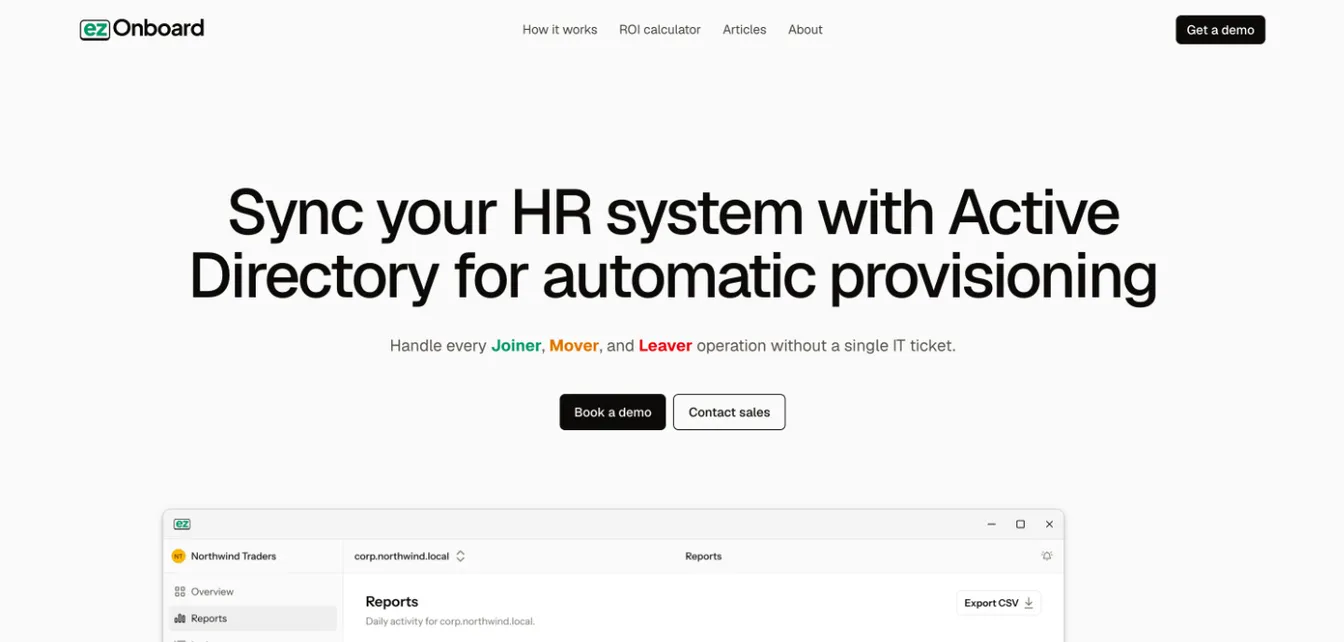
ezOnboard is an automated onboarding solution that integrates your HR software with Microsoft Active Directory (AD). It can bring several benefits:
Seamless Integration with HR Systems
ezOnboard integrates with existing HR platforms, such as Gusto and Deel HR. It automatically reflects changes in employee status and information. It also automates the user onboarding process, which eliminates delays caused by manual approvals and data entry.
Automated Account Creation and Management
This software streamlines the management of user accounts by automating the creation, updating, and deactivation in Active Directory. It can accelerate time-to-productivity and reduce IT onboarding tickets.
Improved Security and Compliance
By automating the employee onboarding flow, ezOnboard reduces the risk of unauthorized access. The software only grants access to authorized users.
Additionally, ezOnboard’s reporting and tracking features give you a detailed audit trail for improved security and compliance. It shows who has access to what resources and when permission has been granted.
Reduced IT Burden
ezOnboard eliminates the need for manual onboarding tasks, such as setting up new accounts and giving account access. It alleviates the burden on IT staff so they can focus on more strategic goals.
Achieve a Seamless User Onboarding Experience with ezOnboard
Start transforming your onboarding process with ezOnboard today. Optimize your onboarding flow and increase security and productivity without any hassle.
Request a demo by clicking here, or see how much money ezOnboard can save you with this ROI calculator.
FAQs about IT Onboarding Analytics
What is onboarding analytics?
Onboarding analytics involves tracking and analyzing data to measure the effectiveness of onboarding processes. It helps IT leaders identify areas for improvement and optimize new hire integration.
What is onboarding in the IT industry?
IT onboarding focuses on equipping new hires with the tools, systems, and knowledge needed to succeed in their roles. It helps new employees quickly adapt to IT workflows and responsibilities.
What are the 4 C's of effective onboarding?
Compliance, clarification, culture, and connection represent key elements of onboarding. They make sure new hires understand IT policies, their roles, and company culture to guarantee a smooth transition.
What tools are used in onboarding analytics for IT teams?
IT teams use onboarding software with built-in analytics capabilities to track key metrics. Other commonly used tools include ticketing systems and advanced data visualization platforms. They collect, analyze, and report data that can identify areas of improvement and optimize user onboarding.
What metrics are important in onboarding analytics?
Key metrics in user onboarding analytics include time-to-productivity, access setup efficiency, employee turnover rates, retention rates, and feedback on training effectiveness. Tracking these metrics helps organizations measure the success of their onboarding processes.